Help: prePiano Four
In prePiano Four, the note names stay the same but the note lengths change. The melodies are starting to feel more lifelike. We now mix regular notes with long notes and even introduce silent notes. Mastering this new combination is the final step before your child is ready to compose their own music.
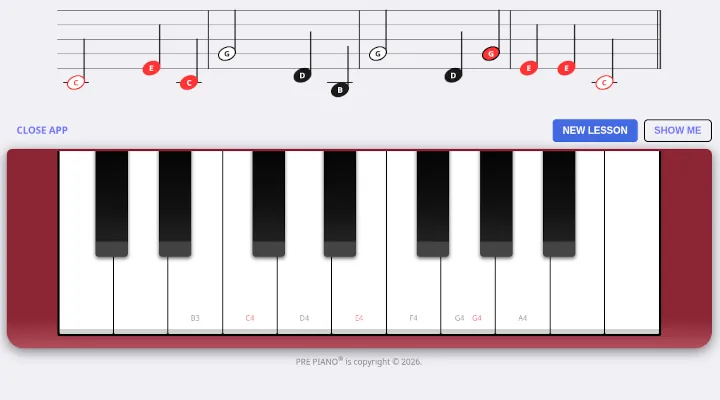
Long Notes
To understand long notes, generate a new lesson and look at the notes. You will see two types of notes. The first type, which you already know, is filled either red or black. The second type is the long note, which is hollow. They still have a name but are no longer filled. The absence of color indicates that the note is long.
How long is a long note?
A long note is twice as long as a regular note. Listen carefully as the built-in music teacher shows you how melodies sound that include long notes.
Silent Notes
All famous songs include silent notes. Silent notes use an X instead of a note name. Here is a trick that always works: when you see a silent note, simply wait for one beat without touching a key. After a few lessons, this becomes second nature. The silence becomes part of the melody.
Practice
When a child reaches level four, practice time may increase from 15 to 20 minutes, or even slightly more. Sometimes, a few minutes more. We are now making real music and there is a lot to get used to. The app still functions the same way.
- Press NEW LESSON to generate a melody.
- Use the SHOW ME button and listen several times carefully.
- If the melody is challenging, break it up into smaller parts. The notes are divided into four sections. It is easier to learn section by section. Once the child can play them, they can join them all together.
It is okay to use the SHOW ME button again and again. Watch and listen as many times as you need. A trick I used when I was learning to tell long and short notes apart: I closed my eyes and just listened. Before long, I began to hear the difference clearly.
A word for mentors: At prePiano level four, you need to become not just the mentor, but also the student. You still explain the material, but you also need to ask questions. After all, yesterday you knew long notes and silent notes, but today, somehow, you have forgotten a few details ;) Let your child fill in the blanks. Picture this conversation before the lesson starts. It helps.
And when the moment is right and your child has taught you enough about long notes and silent notes, excuse yourself, pick up your phone, and call grandma, a sister, or a friend. Tell them how amazed you are at how well your child is playing. Make time for this call, or at least tell another grownup later. If your child overhears you speaking about their progress with that kind of enthusiasm, they are far less likely to do what so many kids do: quit.